
Sage and Rust Crochet Cardigan Pattern
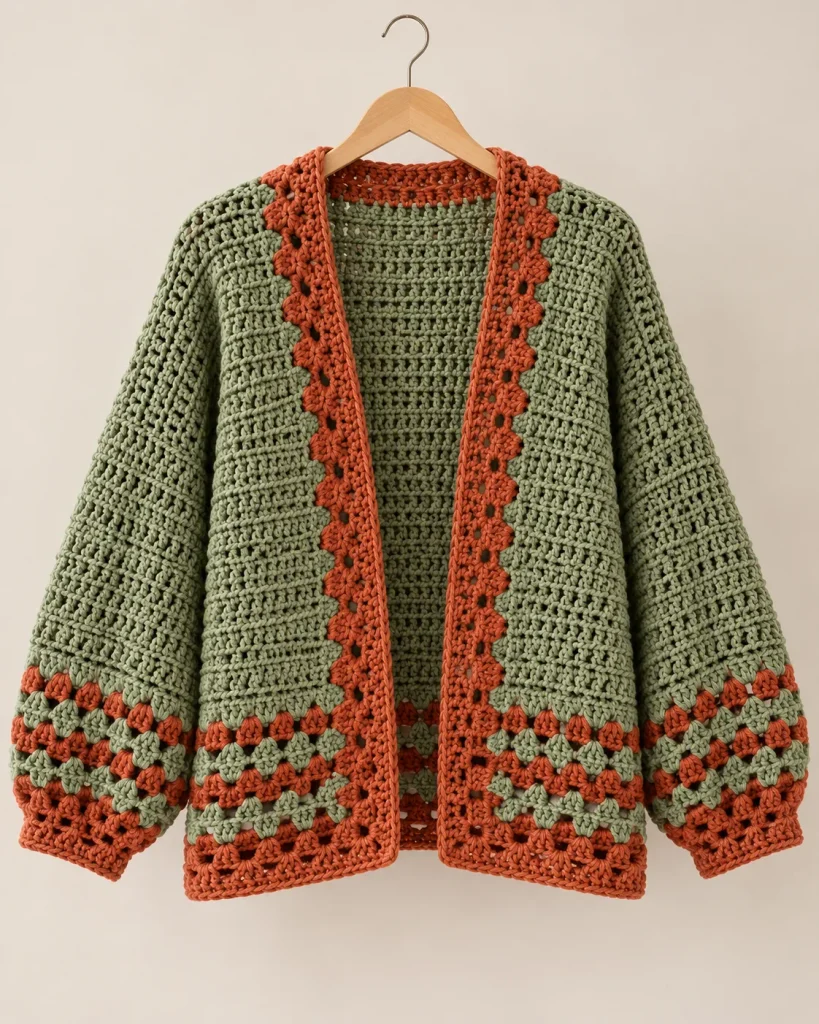
This sage and rust crochet cardigan has such a warm, relaxed look, and I really love how the earthy colors work together.
The main body is crocheted in soft sage green with a lightly open textured stitch, while rust orange adds contrast along the hem, sleeve cuffs, front opening, and neckline. The alternating granny-style bands near the bottom and sleeves give the cardigan just enough color without making the design feel too busy.
It has a comfortable open-front shape, dropped shoulders, long sleeves, and a relaxed fit that makes it perfect for layering through fall and cooler days.
This pattern is written for a women’s medium with a finished chest of about 105 cm / 41.3 in.
Pattern General Information
| Detail | Information |
| Pattern | Sage and Rust Crochet Cardigan |
| Skill Level | Intermediate |
| Size | Women’s M |
| Suggested Bust | 90–96 cm / 35.4–37.8 in |
| Finished Chest | 105 cm / 41.3 in |
| Finished Length | 62 cm / 24.4 in |
| Sleeve Length | 42 cm / 16.5 in |
| Yarn Weight | Worsted / Medium 4 |
| Main Hook | 5 mm |
| Edging Hook | 4.5 mm |
| Estimated Time | 22–30 hours |
| Construction | Separate panels joined before edging |
The cardigan is made from a back panel, two mirrored front panels, and two sleeves. After assembly, a continuous rust band is worked around the front opening and neckline.
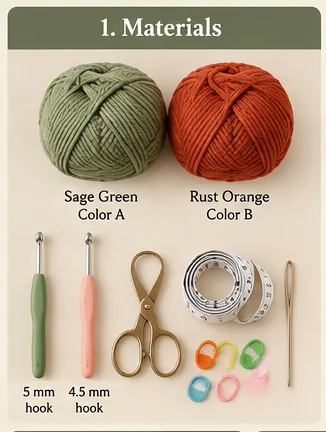
Materials
You will need:
- Sage green yarn: about 650 g / 1,300 m
- Rust orange yarn: about 200 g / 400 m
- 5 mm crochet hook
- 4.5 mm crochet hook
- Yarn needle
- Scissors
- Measuring tape
- Stitch markers
- Pins for assembly
- Blocking surface
- Rustproof blocking pins
A soft worsted-weight cotton-acrylic blend works beautifully for this cardigan because it gives the stitches enough structure while still allowing the garment to drape comfortably.
Make It in Your Own Colors
You can easily change the sage and rust combination.
Cream and terracotta would give it a softer neutral look, while olive and burnt orange would make it feel even more autumnal. You could also try dusty blue with cream, burgundy with beige, or charcoal with mustard.
Just keep both yarn colors in the same weight and fiber family so the fabric stays even.
Gauge
For the main sage fabric:
16 positions × 10 rows = 10 × 10 cm / 4 × 4 in
Work your gauge swatch using the four-row sage texture pattern.
The lower granny bands should block to the same width as the sage fabric above them, so it is worth checking both stitch patterns before starting the full cardigan.
Abbreviations
This pattern uses US crochet terminology.
- ch – chain
- sc – single crochet
- hdc – half double crochet
- dc – double crochet
- dc3tog – double crochet 3 together
- BLO – back loop only
- st / sts – stitch / stitches
- sp / sps – space / spaces
- RS – right side
- WS – wrong side
- FO – fasten off
A granny group means 3 dc worked into the same indicated stitch or space.
A shell means 5 dc worked into one stitch.
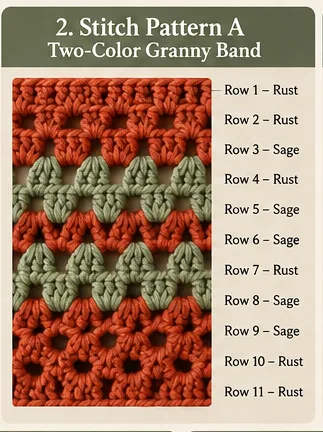
Stitch Pattern A: Two-Color Granny Band
The lower body and sleeve cuffs use the same decorative granny-style band.
The color sequence is:
- Row 1: rust
- Row 2: rust
- Row 3: sage
- Row 4: rust
- Row 5: sage
- Row 6: sage
- Row 7: rust
- Row 8: sage
- Row 9: sage
- Row 10: rust
- Row 11: rust
The alternating colors create the pretty stripe effect along the hem and sleeve ends.
Keep the stitch count consistent across the entire band so it does not flare or pull inward.
Stitch Pattern B: Sage Texture
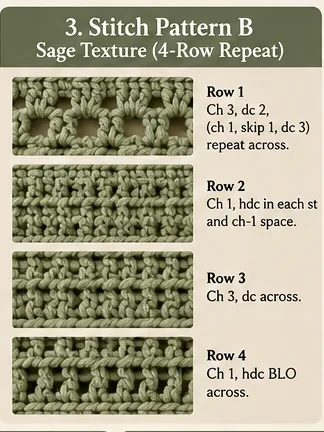
The main cardigan fabric is worked in a four-row repeat.
Texture Row 1
Ch 3, dc in the next 2 sts.
Repeat:
ch 1, skip 1 st, dc in the next 3 sts
Continue across.
Texture Row 2
Ch 1 and work hdc into every dc and every ch-1 space.
Texture Row 3
Ch 3 and work dc across.
Texture Row 4
Ch 1 and work hdc BLO across.
These rows create a soft combination of open texture and subtle raised ridges.
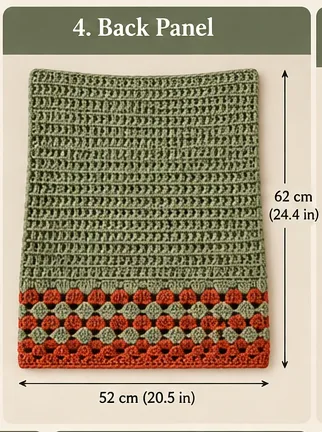
Piece 1: Back Panel
Begin with rust yarn and the 5 mm hook.
Foundation
Ch:
84
Lower Band
Work Stitch Pattern A across 83 positions for rows 1–11.
The finished decorative band should measure about:
10 cm / 3.9 in deep
Change to sage.
Main Sage Section
Work the four-row texture repeat for:
52 rows
Keep 83 positions across every row.
The finished back should measure approximately:
- 52 cm / 20.5 in wide
- 62 cm / 24.4 in tall
Fasten off and leave a long tail for seaming.
At the upper edge, divide the stitches into:
27 shoulder positions / 29 neck positions / 27 shoulder positions
Piece 2: Front Panels — Make 2
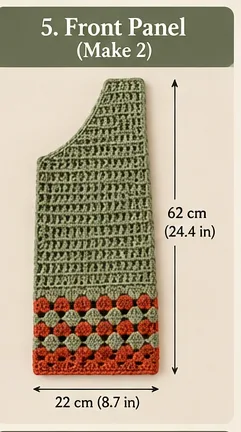
Both front panels begin with rust yarn.
Foundation
Ch:
36
Lower Band
Work Stitch Pattern A over:
35 positions
Complete rows 1–11, then change to sage.
Main Section
Repeat the sage texture pattern for:
44 rows
Keep one edge straight for the side seam and use the opposite edge for the neckline shaping.
Neckline Shaping
The upper eight rows gradually reduce the front edge.
Decrease by working dc3tog on the neckline edge every other row.
The stitch counts move from:
35 → 33 → 31 → 29 → 27
The two fronts should mirror each other, so one neckline slopes on the left and the other on the right.
Each finished front should measure about:
22 cm / 8.7 in wide before shaping
Piece 3: Sleeves — Make 2
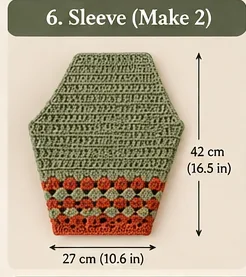
Each sleeve is worked flat from the wrist upward.
Begin with rust yarn.
Foundation
Ch:
44
Patterned Cuff
Work Stitch Pattern A across:
43 positions
Complete rows 1–11.
The cuff should measure about:
- 27 cm / 10.6 in wide
- 10 cm / 3.9 in deep
Change to sage.
Sleeve Shaping
Begin the sage texture with 43 positions.
Every fourth row, increase at both edges by working:
3 hdc BLO in the first stitch and 3 hdc BLO in the last stitch
Each increase row adds 4 stitches.
The stitch count grows:
43 → 47 → 51 → 55 → 59 → 63 → 67 → 71
Continue until you have completed 32 sage rows.
Block each sleeve to approximately:
- 42 cm / 16.5 in long
- 44.5 cm / 17.5 in across the upper edge
- 27 cm / 10.6 in across the cuff
Assembly
Block all five garment pieces before sewing.
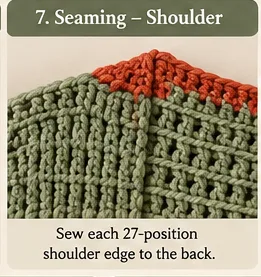
Place the two front panels over the back with the right sides together.
- Sew each 27-position shoulder edge to the matching side of the back.
- Leave the central 29 back-neck positions open.
- Open the garment flat.
- Measure 22 cm / 8.7 in down from each shoulder to mark the armholes.
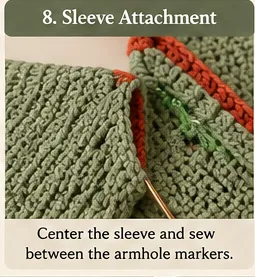
- Center each sleeve over its shoulder seam.
- Pin the sleeve edges evenly between the armhole markers.
- Sew both sleeves into place.
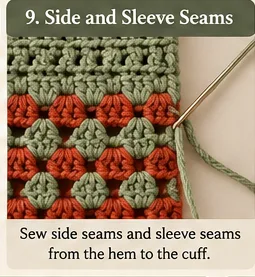
- Fold the cardigan with right sides together.
- Sew from the lower hem to the underarm.
- Continue along each sleeve seam to the cuff.
Turn the cardigan right side out before working the final front band.
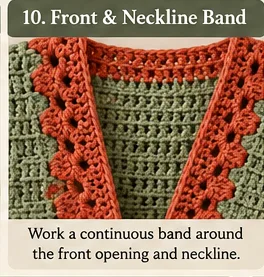
Piece 4: Continuous Rust Front and Neckline Band
Using rust yarn and the 5 mm hook, begin at one lower front corner.
Work evenly up one front edge, around the back neckline, and down the opposite front.
Band Row 1
Work approximately:
235 sc
Distribute the stitches evenly so the band lies flat.
Band Row 2
Work the decorative shell pattern:
sc, skip 2 sts, 5 dc in next st, skip 2 sts, sc
Repeat around the opening.
Band Rows 3–5
Continue with solid sc and hdc rows, finishing with an hdc BLO row for extra texture.
Change to the 4.5 mm hook.
Band Row 6
Work sc across.
Fasten off.
The finished rust band should measure about:
4.5 cm / 1.8 in wide
Final Finishing
Weave all yarn ends securely into matching-color sections.
Check that the granny stripes line up neatly at the side seams and sleeve seams.
Lay the cardigan flat and gently shape the neckline, front edges, hem, and cuffs.
The finished cardigan should measure approximately:
- 105 cm / 41.3 in around the chest
- 62 cm / 24.4 in long
- 42 cm / 16.5 in sleeve length
Allow the cardigan to dry completely flat before wearing or hanging.
Final Thoughts
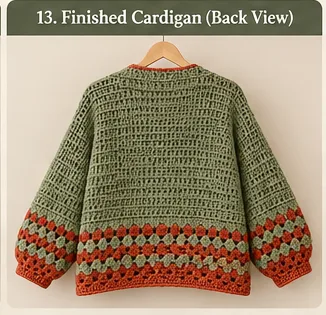
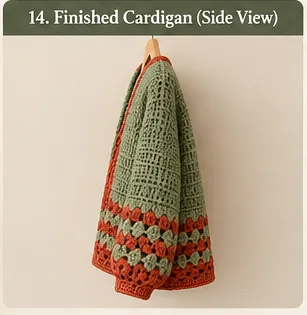
This sage and rust crochet cardigan has such a cozy, handmade feel without being overly complicated.
The soft sage body keeps the design calm and wearable, while the rust edging and granny-stitch bands add warmth and just enough contrast.
I especially love how the open front and relaxed sleeves make it easy to layer over dresses, jeans, or simple fall outfits.
You can keep the original earthy palette or choose your own two-color combination and make the cardigan completely personal.
Either way, the mix of textured sage fabric, decorative cuffs, scalloped rust edging, and relaxed construction makes this a beautiful cardigan to enjoy throughout the cooler seasons.